
What to check before joining a live table
 Available in US
Learn how licensing, table variants, device performance and roulette odds shape the live dealer experience.

New Zealand’s 2026 Licensing Transition for Live Roulette
For Kiwi players looking at live dealer roulette in 2026, the key change is not a new roulette rule. It is a new framework for which online casino operators may serve the New Zealand market. The Online Casino Gambling Act 2026 began taking effect on 1 May, opening a transition period before the licensing cutoff in December.
The Act creates New Zealand’s first domestic licensing system for online casino gambling. Its licence category covers live dealer tables alongside online slots and digital table games, and the sector can have no more than 15 licences. That makes the change relevant to a live roulette table even when the game itself is hosted offshore: the operator’s right to accept Kiwi players is the issue.
What changes on 1 December
The transition runs from 1 May to 1 December 2026. Online casinos that were already serving people in New Zealand before the Act took effect may continue during that window, subject to the transitional rules. This is not a general permission for any new offshore site to enter the market.
Choosing a live dealer roulette site in New Zealand calls for checking the details that are actually available for each operator. Use this list as a starting point, and verify current terms before signing up.
-
Play Grand
- License
- Malta Gaming Authority, licence no. MGA/B2C/370/2017
Play Grand is listed with a Malta Gaming Authority licence, number MGA/B2C/370/2017.
-
Lamabet
- Payout speed
- 1-3 business days
Lamabet lists a payout speed of 1–3 business days.
-
7Bit Casino
- License
- Tobique Gaming Commission, licence no. 0000091
7Bit Casino is listed with a Tobique Gaming Commission licence, number 0000091.
-
BitStarz
- License
- Curaçao Gaming Authority, licence no. OGL/2024/165/0185
BitStarz is listed with a Curaçao Gaming Authority licence, number OGL/2024/165/0185.
-
N1 Casino
- License
- Malta Gaming Authority, licence no. MGA/B2C/394/2017
N1 Casino is listed with a Malta Gaming Authority licence, number MGA/B2C/394/2017.
-
Zotabet
- License
- 07017519840
- Payout speed
- 1-3 business days
Zotabet lists the identifier 07017519840 and a payout speed of 1–3 business days.
-
Ricky Casino
- License
- Tobique Gaming Commission, licence no. 0000002
Ricky Casino is listed with a Tobique Gaming Commission licence, number 0000002.
-
Neospin
- License
- Tobique Gaming Commission, licence no. 0000064
Neospin is listed with a Tobique Gaming Commission licence, number 0000064.
-
Wintino
- Payout speed
- 1-3 business days
Wintino lists a payout speed of 1–3 business days.
From 1 December, operators that have not applied for a licence must stop providing online casino gambling to New Zealand players. A pending application is treated differently: an operator that has applied may keep operating while the Department of Internal Affairs considers the application, but it must not advertise during that period. If an application is declined, the operator has to cease its online casino operations in New Zealand and leave the market.
That distinction matters. “Available” does not necessarily mean licensed, and an application still under review is not the same as an approved licence. The transition allows some existing services to continue while decisions are pending; it does not turn every site that remains accessible into an approved operator. The full licensing regime is expected to be operational in 2027, so the market’s status can change as applications are decided.
The practical cutoff is therefore not simply a matter of checking whether a roulette page loads. An operator may be accessible during the transition yet have a different status under the new framework. Nor does the maximum of 15 licences mean that every operator applying will receive one. There is a cap, and the Department’s decisions determine who qualifies.
Offshore access and the local framework
Before this Act, online casinos could not be based in New Zealand under the Gambling Act 2003, and offshore online casino services were not licensed or supervised by a New Zealand regulator. That did not prevent Kiwi players from accessing international sites, and players are not prohibited from playing live dealer games offshore. The difference was that customers wagering with those sites had no domestic government recourse.

The 2026 framework changes the oversight of providers serving the market; it does not establish a separate Kiwi-specific licence for roulette. A live dealer casino is covered through the online casino licensing system, not a special permit for one game or table format. An offshore operator may also hold approval from a regulator in another jurisdiction, but that foreign oversight is not the same thing as a New Zealand licence.
I treat those checks as separate questions. First, is the operator regulated by a recognised gambling body? Second, what is its status with the Department of Internal Affairs under New Zealand’s new system? A positive answer to the first does not, by itself, answer the second. That is the point often obscured by broad phrases such as “regulated casino”: the regulator and the territory it supervises matter.
Checking an operator’s position
The Department of Internal Affairs is the place to confirm an operator’s New Zealand licence status. The check should match the operator’s actual legal identity, rather than rely only on a brand name displayed on a website. Where the status is unclear, the distinction between an approved licence, a pending application and no application is material, particularly around the December transition date.
Do
- Check the operator's actual legal identity
- Confirm status with the Department of Internal Affairs
- Verify if the operator is regulated by a recognised gambling body
Don't
- Rely solely on a brand name displayed on a website
- Assume offshore licensing equals New Zealand approval
- Treat promotional claims as proof of regulatory status
For an offshore site, its own licensing information can indicate which recognised gambling body supervises it. That is useful context, but it should not be treated as proof of approval under New Zealand’s regime. A site may state that it is licensed elsewhere while its New Zealand position is still subject to the transition or a DIA decision.
The rules also place limits on how operators may promote these services during the transition. In particular, providers operating while an application is pending must not advertise. This makes promotional claims a poor substitute for checking status: the relevant information is the operator’s regulatory position, not how prominently a roulette table is presented.
The change is staged, not instantaneous. The Act has set the framework, existing providers have a transition window, and the December date separates those that have applied from those that have not. For live roulette, the table may look much the same; the legal basis for the operator accepting New Zealand players is what changes.
What the Dealer and Live Feed Add to Roulette
A live roulette table is not a digital wheel dressed up with a video window. The wheel, ball and dealer are physically present, while a camera feed brings the table into the online game. The broadcast may come from a studio or a casino in another country; either way, the central difference is that a real dealer conducts the round in real time.
That changes what the game shows. A software-only roulette game presents an animated result. A live table shows the wheel being operated and the ball travelling around it before the dealer announces the outcome. The video is not just atmosphere: it is the visible account of a round taking place at a physical table.
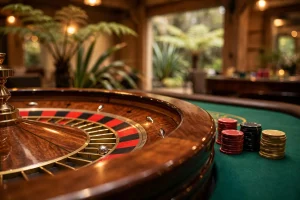
The distinction matters because “immersive” is often used as if it described a special mathematical feature. In this context, it describes the presentation: a streamed dealer, a real wheel and a shared table interface. It does not, by itself, tell anyone how a roulette game is configured or what its return characteristics are. The experience is more tangible; the word is not a probability measure.
A live roulette dealer also gives the session a human point of contact. Players can interact with professional dealers through the game interface, while the dealer manages the physical round and communicates its progress. That interaction is different from selecting a bet on a screen and watching an animation resolve it. There is a person at the other end of the feed. Not a simulation.
From the operator’s side, the video has to connect the table action with the software display. The camera shows the round, while the interface provides the means to take part remotely. Those two layers make the game legible: the stream carries the physical action, and the digital controls carry the player’s choices. A camera alone would be a broadcast; the linked interface turns it into online play.
This is why a live dealer table can feel less abstract than a purely digital version, even though the player is still watching through a screen. The wheel is real, but access is mediated by the feed. The dealer is present, but not in the same room. The game combines a physical event with an online interface rather than replacing one with the other.
The broadcast format also means that the table is shared. The dealer’s actions are part of the same live round being shown to the players connected to that table, rather than a separate animation generated for each screen. That shared sequence gives the game its pace and makes the dealer’s role easy to understand: conduct the round, present the result and keep the table moving.
For Kiwi players, the practical appeal is often this combination of visible equipment and human interaction. But the live format should not be mistaken for a guarantee of a better experience in every respect. It is a different presentation of roulette, with a real wheel and professional dealer shown on video. The feed adds presence; it does not change what roulette is.
Why Free Live Roulette Is Hard to Find
A free live roulette table sounds like a simple offer: the same wheel and dealer, with no money at stake. In practice, the live format has operating costs that a digital game does not carry in the same way. Casinos have to pay for a staffed table and the studio environment around it, then keep the live broadcast running. That cost helps explain why free access is limited.
I have seen “free” used as though it describes a permanent version of a game. Often it describes an offer, a mode, or a short-lived promotion instead. Those are not interchangeable. A casino may provide free access to some digital games while reserving its live dealer tables for real-money play. The difference is not necessarily a technical obstacle; it is a business decision about which products the operator is prepared to fund without a wager attached.

A live table is a service, not just a roulette interface. The operator pays for real equipment, a professional studio and people to run the table. The live feed also has to be produced and delivered as part of the product. Those costs continue whether a particular player places a bet or not. When a casino opens a table for free use, it still bears the expense of making that table available, while removing the revenue it would expect from wagering.
That is the basic trade-off. Digital roulette can be presented without running a staffed physical table, so offering it at no charge is easier to fit into a casino’s product mix. Free live dealer roulette is a different proposition: it means giving access to a service with ongoing operating costs. The operator may decide that the expense makes sense for a promotion, but that does not mean the table will remain free or be available in that form whenever someone visits.
This is why a search for free online live dealer roulette can lead to mixed results. A page may use “free” in its headline while describing a promotional condition, a digital roulette game, or a feature that is not available on every table. The label alone does not tell whether a real dealer and wheel are being streamed without wagering. The distinction matters; otherwise, a free digital game can be mistaken for a free live table.
The same applies to phrases such as “fun mode” or “challenge.” They can describe a presentation or a promotion, but they do not by themselves establish that the live table is open for free play. I would treat the wording as a starting point, then check the actual table description and its terms. If the offer depends on a specific event or account condition, that is different from a general free-play option.
“Live dealer roulette free play” is also not a promise that every part of the experience is available at no cost. An operator can make a limited offer without changing the usual access model for its live tables. The practical question is whether the free access applies to the live roulette table itself, rather than to another roulette product or a separate promotional feature. Clear terms should say what is included.
Some terms are especially easy to misread. “Spread bet roulette,” for instance, may appear alongside live roulette wording, but the phrase does not establish that a free live table exists. Nor does a “live dealer roulette challenge” necessarily mean players can join a real table without wagering. These labels need to be read in context, not treated as standard names for free versions of the game.

Operators have a reason to make the distinction visible in their product design. A free digital game can serve as a low-cost way to introduce a roulette interface. A staffed live table has a different cost base, so an operator may reserve it for paid sessions or use free access only as a controlled promotion. That is not a judgement about the quality of the table. It is the commercial logic behind what is offered without a stake.
There is also a difference between a table being technically capable of accepting free play and an operator choosing to enable that option. The presence of a live stream does not prove that a no-cost mode is available. Product pages and promotional copy can make “free live roulette” sound like a standard category, when in practice availability depends on the operator’s own setup and offer.
I would not assume that a free option will be there simply because a casino has live roulette. Look for wording that explicitly applies to the live table, and distinguish it from free digital roulette or a time-limited promotion. If the terms are vague, the headline is doing more work than the offer. A small distinction, but an important one.
The short version is that free access is uncommon for an economic reason: a live dealer table costs money to operate, even when a player is not wagering. Casinos can choose to absorb that cost for a particular offer, but they have less incentive to make the service freely available as a permanent option. That is why free live dealer roulette is harder to find than free digital roulette. Not a mystery. A cost decision.
Free Practice at an Online Casino: What It Can and Cannot Show
Free practice can make the layout of a roulette game less unfamiliar. It may let a player explore the betting area, see how selections appear on the table and learn where to find the controls before committing money. That is useful for orientation. It is not the same as taking part in a live round with a real stake.
The distinction matters because “free” can describe different things. A practice mode may use a simulated game, while a live table may let people watch without betting. Neither should be assumed to reproduce every condition of wagering in real time. The available features depend on the particular game and site.
In a simulated version, the interface can show how a bet is placed and how a result is displayed. It can also help identify whether the controls feel clear or awkward. But the activity is not a live wager: there is no money at stake, and the pace may not match the table being streamed. A practice screen can teach the buttons. It cannot stand in for every decision made during an actual round.
Watching a live dealer roulette game without placing a bet is different again. The feed may show the live table, but observation alone does not give the viewer the same task as a player selecting a wager before the round closes. It is possible to follow the action, yet still have no hands-on practice with the live betting controls.

The live betting window changes the exercise
Most live games give players a limited period to place bets. Once that window closes, the round proceeds, so the pace is quicker than a practice mode that allows a pause or repeated adjustment. That time limit is part of the live format, not a detail a free simulation can reliably reproduce.
I have seen players treat practice as rehearsal for the real table, then discover that the useful part was learning the interface rather than learning the timing. In a live session, the decision has to be made while betting is open. A no-cost mode can help make the controls familiar, but it cannot create the pressure of a wager or guarantee that the practice version follows the live table’s pace.
The practical test is to separate what is being learned. If the aim is to understand where to select a bet or how the game displays it, a practice option may be enough. If the aim is to experience the timing of live play, watching a table can show its rhythm, but only an open betting window lets a player place a live wager. Those are different kinds of experience.
“Risk-free” is an advertising phrase that needs a narrow reading. It may mean that no money is being staked in a particular mode; it does not mean the mode reproduces every condition of live betting. Nor does practice demonstrate what a player will do when a real stake is involved. The interface is familiar. The decision is not.
Practice vs Live Play
Practice modes can help you learn the interface and betting controls, but they cannot replicate the timing or the pressure of a live betting window.
For anyone comparing free online live dealer roulette practice with paid play, the useful question is not whether one is a perfect substitute for the other. It is what each can demonstrate. Practice can clarify controls and basic flow. A live table shows the actual betting window and its pace. Neither turns a free session into evidence about future results.
Playing Live Roulette on a Smart Device
A phone or tablet makes it possible to play live dealer roulette away from a desktop, but the smaller screen changes how the session feels. The table, betting layout and controls all compete for space. On a larger display, it is easier to keep the video and the betting area in view together; on a phone, one may need to give up some of that overview or move between parts of the screen.
That is not merely a matter of comfort. When the picture is reduced, details can be harder to distinguish, and controls may feel crowded. I have found that a screen which works well for reading or messaging is not automatically well suited to following a live table. The device remains usable, but the player’s attention has to do more work.
Connection quality matters too. A live game depends on a video stream reaching the device, so a weak or unstable connection can interrupt the view or make the session less smooth. A specialist review has also noted that live dealer games can run into technical problems. That is a possibility, not a promise that every session will be affected. Still, it is worth treating the stream as a point of dependence rather than assuming the table will remain uninterrupted.

The practical difference between a phone and a tablet is mostly the amount of screen available. A tablet can offer a more spacious view without requiring a desktop setup; a phone is easier to carry, but leaves less room for the video and interface to sit comfortably together. Neither device changes the roulette game itself. They change how clearly the session can be followed.
A stable connection and a screen that makes the table legible are the useful basics. If the stream stalls or the interface becomes difficult to read, continuing may be less useful than pausing and checking the connection. There is no need to treat a technical interruption as a strategic signal: it is an access problem, not information about the next result.
The device is the weak link sometimes.
Roulette Results, House Edge and the Limits of a System
A run of roulette results can look as though it is pointing somewhere. After several outcomes of one kind, a different result may feel overdue; after a win, repeating the same bet can seem justified. I have seen both readings turn a sequence into a story. The story does not alter the odds of the next spin.
A betting system is a rule for choosing or changing stakes. It may tell a player to increase a bet after a loss, reduce it after a win, or keep the same stake throughout. That can make a session feel structured, and it changes how money is exposed as results arrive. It does not change the roulette game’s underlying probabilities. A system organises decisions. It does not give the wheel a memory.
European Roulette
Features a lower stated house edge of approximately 2.7%.
American Roulette
Features a higher stated house edge of approximately 5.26%.
The house edge is the more useful measure when assessing what a routine can and cannot do. It represents the game’s mathematical advantage for the operator over continued play, not a forecast of the next result. For live European roulette, the stated figure is around 2.7%; for American roulette, it is around 5.26%. Those figures describe different versions of the game, not the effect of a betting method. The distinction between them is worth keeping clear.
A player can still win during a session. Short-term results vary, and a favourable run may leave a player ahead for a time. But a sequence of live dealer roulette results is not evidence that a system has overcome the house edge. Nor does a losing run prove that a reversal must arrive. That is the point at which a routine often gets mistaken for a prediction.
The phrase “best system” usually sells certainty where there is only a staking preference. A progression can make losses grow more quickly when outcomes go against it; a flat stake avoids that particular escalation but does not improve the game’s odds. Neither approach turns roulette into a favourable proposition. Different routines change the shape of risk, not its source.
When I assess a live dealer roulette system, I separate two questions: what does it ask the player to do with each stake, and does that rule actually change the house edge? The first can be answered by looking at the routine. The second cannot be answered in its favour: a betting pattern does not rewrite the game’s mathematics. That is also why there is no objectively “best” live dealer roulette system on the basis of a sequence of wins. A memorable result is still just a result.
The useful conclusion is modest. Results matter to the session, but they do not validate a system or predict what comes next. The edge remains.
European and American Roulette at a Live Table
The meaningful difference between European and American roulette is the house edge, not the fact that both are presented by a live dealer. The stated edge for live European roulette is around 2.7%, while the figure for live American roulette is around 5.26%. Those percentages describe the casino’s mathematical advantage over extended play, not a prediction of what will happen in an individual round.
That distinction matters when a table’s presentation makes two versions look broadly similar. A live video feed, professional dealer and physical equipment do not make the underlying odds interchangeable. The format remains part of the game’s mathematics, even when the interface and pace of play feel familiar.
I have seen “same game” used as a convenient shorthand in casino descriptions. It can mean that the table follows the familiar roulette format, but it should not be read as meaning that every version carries the same edge. The figures tell a different story. European roulette has the lower stated house edge of these two; American roulette has the higher one.
A demo, where offered, can help show how a live table is arranged and how its controls are presented. It cannot make the distinction between formats disappear. Nor does a practice session establish that the live version has the same mathematical profile as another roulette table. The relevant comparison is the version’s stated edge, not whether the screen looks similar or the controls seem easy to follow.
The word “European” or “American” therefore does useful work in a table description. It identifies which set of roulette odds applies. If that detail is absent, a polished studio shot or a familiar layout is not a substitute for it. The table’s label and information panel are more informative than its visual style.
House-edge figures are averages over extended play, so they do not tell a player what a single spin will produce. They do, however, make the comparison concrete: the two live formats do not carry equal mathematical terms. A short winning run can happen at either table; it does not alter the stated edge.
For a format comparison, that is the practical point. European roulette carries the lower of the two stated edges, while American roulette carries the higher one. The live presentation may be similar. The odds are not.
Low-Stakes Live Roulette and the Role of Strategy
Low-stakes live roulette changes the scale of each decision, not the mathematics underneath it. A smaller wager means less money is committed on an individual spin, but it does not alter the house edge attached to the game. That distinction is easy to blur when a table is described as “gentle” or “beginner-friendly”. The label may refer to the size of the available bets; it does not mean the odds have become more favourable.
For live European roulette, the stated house edge is around 2.7%; for American roulette, it is around 5.26%. Those figures describe the game’s built-in advantage over repeated play. A staking approach cannot remove that advantage. It can only determine how much is at stake on a particular bet and how quickly a session’s funds are exposed.
That is where a strategy can be useful, if the word is kept in proportion. I have seen players treat a pattern of changing stakes as if it were a way to read the wheel. It is not. A staking plan is a rule for handling money, not a method for changing the result or improving the underlying odds. The distinction matters most after a run of wins or losses, when the next bet can feel more predictable than it is.
With low stakes, the practical decision is about keeping each wager consistent with the amount set aside for play. A modest bet may make a losing result easier to absorb, but repeated bets still accumulate exposure. Lowering the stake does not make a long session mathematically safer; it reduces the size of each individual commitment. That is a smaller claim, and the accurate one.
Live dealer roulette also gives each decision a fixed place in the round: a stake is chosen, the result follows, and the next opportunity arrives. A plan made before play can help keep decisions from being rewritten in response to the last result. It cannot guarantee a particular session outcome. Nor does a table’s live presentation change the edge.
- Ensure the stake fits your intended spending limit
- Determine if the staking pattern is for management or prediction
- Verify the game version (European vs American) to understand the edge
I would separate two questions. Is the stake small enough to fit the player’s intended spending? That is a personal limit. Does the staking pattern beat roulette’s built-in disadvantage? No. Keeping those questions apart is more useful than dressing a sequence of bets up as a system. Low stakes, not changed odds.
Roulette Apps: Live Timing and Technical Interruptions
An app does not set the pace of a live roulette table; the table does. In most live games, the betting window is limited, so decisions have to be made before the dealer closes betting and the round moves on. That creates a different rhythm from a game that can be paused at any point. A delay spent considering a bet can mean the window has closed.
I have seen “seamless” used to describe live play. In practice, it means the software is designed to keep the stream, betting interface and game state aligned. It does not mean every session will run without interruption. A specialist review notes that live dealer games can experience technical problems. That is a reported possibility, not a promise that every app will fail—or a guarantee that a particular one will not.
For roulette, the timing matters because a connection interruption can coincide with an open betting window or a round in progress. The app may stop responding, the video may lag, or the player may lose sight of what is happening at the table. The exact consequence depends on the operator’s rules and the point at which the interruption occurs; there is no single outcome that can be assumed across all live dealer roulette apps.
The useful habit is procedural, not predictive: know where the operator explains interrupted rounds and unsettled bets before starting a session. If the feed or controls stop behaving as expected, repeatedly tapping the screen can make the situation harder to read. Check the displayed game state and the account’s transaction or bet history once service returns, then use the operator’s support channel if the record remains unclear.

That is the practical meaning of live dealer roulette tips for an app session. The betting window rewards attention, while a technical fault can disrupt it. Neither changes the roulette result, and neither makes a quick decision more likely to succeed. Keep the pace in view. Keep records clear.
Can You Win at Live Dealer Roulette?
Yes, a player can leave a live roulette session ahead. A winning result is possible; it is not the same as having a reliable way to produce one. The distinction matters. A short run can favour a player, while the game’s built-in edge remains in place across continued play.
I have seen “win” used as if it described a method. In practice, it describes an outcome. No betting routine can make a roulette result certain or remove the mathematical disadvantage built into the table.
The version matters to that calculation. Live European roulette has a house edge of around 2.7%, while the figure for American roulette is around 5.26%. These percentages describe the game’s long-run advantage over players, not a prediction of what will happen in the next spin or session. A player may win despite the edge; the edge does not promise that every player will lose.
That is the useful answer to how to win live dealer roulette: there is no dependable formula. A favourable session can happen, but it cannot be secured by a system or inferred from one result. The dealer and live presentation do not alter the underlying odds.
The plain conclusion is less dramatic than casino copy. Winning is possible; reliable control is not. A result is a result.
Can New Zealand players play real-money live dealer games at offshore casino sites?
Yes. New Zealand players are not prohibited from playing at offshore sites, but should check that the operator is regulated by a recognised gambling body and confirm its New Zealand status with the Department of Internal Affairs.
Do live dealer games have a house edge?
Yes. Live European roulette usually has a house edge of around 2.7%, while American roulette is around 5.26%.
How do live casinos work?
A live casino streams a real dealer and physical table from a studio or casino, so players can place bets and follow each round as it happens. Most games allow only a limited time for betting.
What games can I play at a live casino?
Live casinos offer roulette, blackjack and baccarat, among other live dealer table games.
Casino Games in New Zealand: Roulette, Blackjack & More
Content created by the «casinoguidenz.com» team