
Separate the game mechanics from the legal claims
 Available in US
Automation may affect how bets are placed or results are presented, but it does not create different roulette rules or prove a product is legally available.
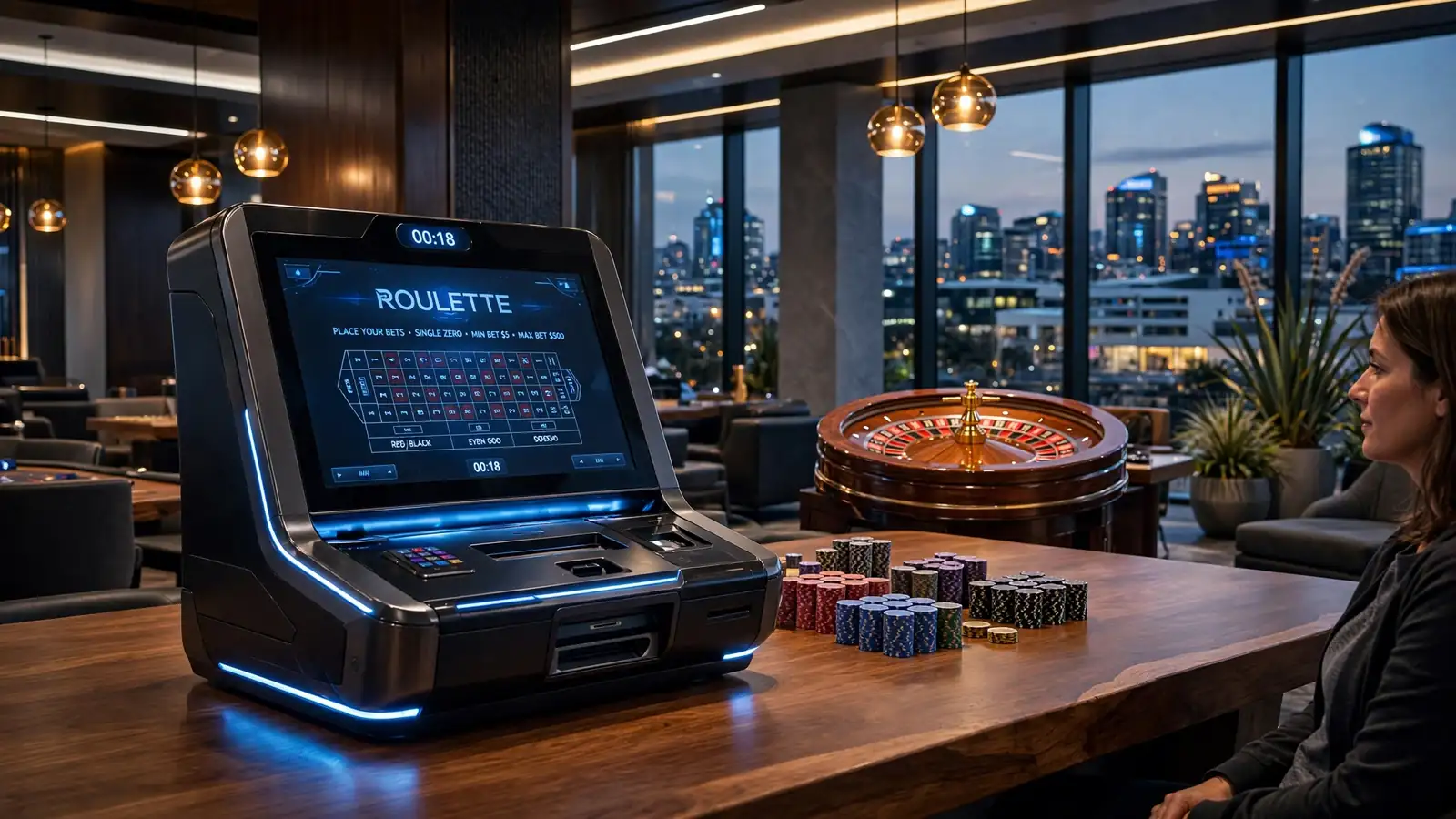
Automated Roulette in 2026: The Game and the Market Rules
“Automated” describes how roulette is presented or operated, not a separate set of betting rules. The familiar choices remain: place chips on a particular number, choose red or black, select odd or even, or cover a combination of numbers. The label alone does not establish who operates the game, where it is based, or whether it falls within New Zealand’s licensing framework. Those are separate questions.
That distinction matters in 2026. A search for automated roulette in New Zealand can point towards different kinds of online play, but a product’s name or interface is not proof of its legal status. I have seen marketing language do a lot of work in very little space. “VIP” may sound like a regulatory category; it is not one. Nor does wording such as “auto-spin” settle whether a provider may lawfully offer online casino gambling in the country.
The game and the legal setting
The game’s basic choices are easy to recognise: chips go onto a roulette layout and represent the selected bets. The market rules around an online casino are less immediate, and they changed during 2026. New Zealand’s Online Casino Gambling Act 2026 came into force on 1 May that year, creating the country’s first domestic licensing framework for online casino gaming.
Automated roulette can be a convenient way to explore roulette games in New Zealand, but operator details matter when choosing where to play. This reference card highlights the verified information available for each listed operator.
-
Play Grand
- License
- Malta Gaming Authority, licence no. MGA/B2C/370/2017
Play Grand is listed with a Malta Gaming Authority licence, number MGA/B2C/370/2017.
-
Lamabet
- Payout speed
- 1-3 business days
Lamabet lists a payout speed of 1–3 business days.
-
7Bit Casino
- License
- Tobique Gaming Commission, licence no. 0000091
7Bit Casino is listed with a Tobique Gaming Commission licence, number 0000091.
-
BitStarz
- License
- Curaçao Gaming Authority, licence no. OGL/2024/165/0185
BitStarz is listed with a Curaçao Gaming Authority licence, number OGL/2024/165/0185.
-
N1 Casino
- License
- Malta Gaming Authority, licence no. MGA/B2C/394/2017
N1 Casino is listed with a Malta Gaming Authority licence, number MGA/B2C/394/2017.
-
Zotabet
- License
- 07017519840
- Payout speed
- 1-3 business days
Zotabet lists licence number 07017519840 and a payout speed of 1–3 business days.
-
Ricky Casino
- License
- Tobique Gaming Commission, licence no. 0000002
Ricky Casino is listed with a Tobique Gaming Commission licence, number 0000002.
-
Neospin
- License
- Tobique Gaming Commission, licence no. 0000064
Neospin is listed with a Tobique Gaming Commission licence, number 0000064.
-
Wintino
- Payout speed
- 1-3 business days
Wintino lists a payout speed of 1–3 business days.
The change did not mean that every online casino became locally licensed on that date. The Act provides a transition from 1 May to 1 December 2026. Providers that were already serving people in New Zealand before the new law took effect may continue during that period, subject to the Act’s transitional provisions. The transition is a bridge to the new regime, not a statement that all operators have completed a licensing process.
The Gambling Act 2003 did not permit online casinos to be based in New Zealand. Before the 2026 law, offshore online casino gambling was not licensed or supervised by a New Zealand regulator. A customer who wagered with an offshore website in that earlier period had no domestic government recourse. That history explains why the new framework is significant; it should not be mistaken for a guarantee about any particular website or game.
The responsibilities are divided between public bodies. The Department of Internal Affairs is New Zealand’s primary gambling regulator and oversees regulation of the online casino licensing framework. The Gambling Commission hears and decides casino licence applications. It is also responsible for issuing online casino licences and approving changes to licence conditions. In practice, that division matters: broad oversight and individual licensing decisions are not the same function.

What the transition means in 2026
A provider’s position depends on the timing and status of its operations, not on whether its roulette page looks familiar. Existing providers covered by the transition can continue only within the terms set by the Act. Providers that have not applied for a licence must stop conducting online casino gambling in New Zealand by 1 December 2026. If an application is declined, the provider must cease its online casino operations in the country and leave the market.
The full licensed regime is not expected to be fully operational until 2027. Unlicensed operation is expected to become an offence from around the middle of that year. These are regulatory milestones, not roulette features. They do not change the bets available on a table, and they do not make the words “automated roulette machine” a reliable way to identify a provider’s status.
During the transition, advertising to people in New Zealand is prohibited. The framework also sets tighter age and identity verification requirements for licensed operators. Advertising by licensed operators is permitted only under tight rules, while sponsorships are prohibited. These conditions are part of how the new system is being established; they are not a reason to treat promotional claims as evidence of a licence.
For a reader comparing the mechanics of an auto roulette casino with the rules governing online gambling, the useful separation is simple: the table describes the game; the law describes who may offer it and on what terms. A familiar layout, automated presentation or polished label cannot answer the licensing question. The legal position depends on the provider’s circumstances under the Act and its transitional provisions.
I have found that this is where the wording often gets blurred. A game can be described in ordinary terms without implying that a specific operator is approved, currently licensed or suitable. The 2026 framework is the material change: New Zealand moved from having no domestic online casino licensing regime to establishing one, with a transition before the full system is expected to operate. Keep the two layers apart. Game mechanics are one matter; permission to provide the service is another.
What a Roulette Strategy Can—and Cannot—Change
A roulette strategy can change the decisions made before a result: which outcomes to cover, how to divide a stake, and when to stop placing bets. It cannot change the numbered pocket where the ball lands. That distinction is easy to blur in systems marketed as “disciplined” or “planned”. A plan may organise betting; it does not control the result.
I have seen the distinction get lost when a sequence of bets is described as though its structure gives it influence over the table. It does not. A player can choose a specific number, a colour, an odd-or-even outcome, or a combination of numbers. Those choices define what would count as a winning bet. The pocket determines whether that condition is met.
That is the practical limit of an auto roulette strategy. It can specify what to select and how to respond to a win or loss, but it cannot make the chosen outcome more certain. A strategy built around repeating a selection still depends on the result matching that selection. A strategy that changes selections after a loss is still making a new wager, not correcting the previous result.

What the plan actually controls
A betting plan can set boundaries around conduct. It might prescribe which categories of bets to use, how much of an intended budget to place on each choice, or when to stop. These are decisions about exposure and consistency. They may help keep a session aligned with a player’s own limits, but they should not be presented as a route to guaranteed profit.
The label “automated roulette machine strategy” can also suggest that automation adds an advantage. In reality, a rule for selecting bets remains a rule for selecting bets. If a system repeats a chosen pattern or switches after a particular outcome, the pattern affects the wagers being made. It does not alter the pocket that decides the result.
This matters because a sequence can look persuasive after the fact. A run of one colour, for instance, may encourage a player to expect a change or to expect the run to continue. Either expectation is still a betting judgment. The previous results do not turn a chosen next bet into a certainty. A record of past outcomes can describe what happened; by itself, it does not secure what will happen next.
No special software changes that boundary. Automated roulette software may be used to place or organise bets, but a betting instruction is not a prediction with control over the outcome. A sequence presented as “smart” may simply apply its rules consistently. Consistency is not certainty. A tidy system can still lose.
Settlement is not a promise
Once the ball falls into a numbered pocket, the result determines which bets qualify as winners. Winning bets are then paid automatically according to the type of bet placed. The payout rule matters because different selections are settled according to the bet made; it does not mean a strategy can force the result to qualify.
That distinction is useful when comparing plans. One may favour a narrower selection, another a broader one, and another may change the selection over time. Each approach changes what the player has staked on. None changes the fact that settlement follows the pocket where the ball lands. A plan can make the decision process more orderly. It cannot make the table owe a win.
In my experience, the most misleading wording is not always an explicit promise. It can be the suggestion that a strategy “beats” roulette because it has a pattern, a progression, or a disciplined stopping rule. Such language often confuses control over the bet with control over the result. The first is real; the second is not.
Real auto roulette does not make this distinction disappear. Whether bets are selected manually or according to a pre-set approach, the player’s choices define the wager, while the result decides whether it wins. A strategy may be useful as a personal framework for making choices and maintaining limits. It should not be mistaken for a guarantee.
The boundary is simple. Choices are controllable. Results are not.
What “Auto Roulette” Means at the Table
“Auto Roulette” describes a roulette table where the main steps are handled through the table interface: chips are selected, bets are placed, the ball falls into a numbered pocket, and winning bets are settled automatically. The word “auto” can make the format sound more mysterious than it is. The table still turns on the same basic relationship between a wager and the pocket where the ball lands.
A bet begins with choosing a chip and placing it on the table layout. The layout allows wagers on a specific number, or on broader outcomes such as red or black and odd or even. Combinations of numbers can also be covered. Those choices define which results count as a win for that bet; they do not alter where the ball will land.
That distinction matters. The betting surface is an interface for recording selections, not a forecast of the result. A chip placed on a number represents a bet on that number. A chip placed on red represents a bet on that colour. The selection is registered before the result is settled, and the relevant question afterwards is whether the ball’s pocket matches the bet’s conditions.
The pocket supplies the result. Each pocket carries a number, and the number where the ball comes to rest determines the winning outcome for the spin. It is not the chip position, the colour of a table marker, or the order in which bets were made that decides the result. The pocket does.
Settlement follows the type of wager. A winning bet is paid automatically according to what was placed: a bet on a single number is treated as that kind of bet, while a colour, parity, or combination wager is assessed by its own conditions. Automatic payment removes the need for a separate manual calculation at the table, but it does not make all bets equivalent. The layout and the bet type remain central.
Manual Selection
The player chooses chips and places them on the table layout.
Automated Settlement
Winning bets are paid automatically according to the type of bet placed.
The Result
The numbered pocket where the ball comes to rest determines the winning outcome.
I have seen “automated” used as if it described a different game. At the table, it is more useful to read it as a description of how the interaction and settlement are handled. The player still chooses where to place chips; the numbered pocket still supplies the outcome; the table applies the relevant payout. No extra prediction is hidden in the label.
A common point of confusion is to treat automatic settlement as automatic betting. They are different ideas. Settlement concerns what happens after the ball lands and a bet qualifies as a winner. The presence of that process says nothing by itself about whether bets are placed without a player selecting them. The important mechanics here are simpler: a wager is recorded against an outcome, the pocket determines the result, and the table pays qualifying bets according to their type.
That is the table-level meaning of automated roulette. The interface may present the choices in a compact form, but the underlying logic remains legible: select chips, cover an outcome, then let the numbered pocket resolve the bet. The label changes little. The mechanics do the work.
Live Auto Roulette: The Dealer Changes the Setup
“Auto” can suggest that a computer generates the result, but in live-dealer roulette the defining feature is different: a human dealer runs the game, and the product does not use an RNG system. The label may describe an automated interface or a style of play; it does not turn the live table into software-generated roulette.
That distinction matters because the source of the result changes. In a live game, the dealer and physical roulette setup are part of what is shown to the player. The outcome comes from the live table rather than from an RNG. The screen is a way to follow the game, not evidence that a random-number system is deciding the result behind it.
From the industry side, labels can do more work than they first appear to. “Live” identifies the dealer-led format. “Auto” may be used alongside it to describe how the game is presented or how a player interacts with the table. Those words are not interchangeable descriptions of the outcome mechanism. The operational distinction is plain: live dealer products do not use an RNG system.
That does not mean every other part of the experience is necessarily identical between live tables. A digital interface can still sit around a live game, and the existence of that interface does not change the stated distinction. It is easy to mistake a polished screen for a software-generated result. The result mechanism and the presentation layer are separate questions.
Nor does “live” make an outcome predictable. A dealer-led setup is not a method for forecasting where the ball will land, and the presence of a person at the table does not turn roulette into a game with a dependable pattern. The label tells what kind of product is being described, not what the next result will be.
This is the point where the phrase “live auto roulette” needs careful reading. It can sound like a contradiction if “auto” is taken to mean that software determines every result. In practice, the relevant distinction is whether the game is a live dealer product. If it is, it does not use an RNG system. The word “auto” alone cannot establish otherwise.
Live vs Software
In live-dealer roulette, a human dealer runs the game and the product does not use an RNG system, whereas software-based roulette relies on a random number generator to produce results.
For the same reason, a live casino auto roulette listing should not be assessed by its name alone. The name is not a technical explanation. The meaningful question is whether the product is live dealer roulette or a software-based option. Those formats use different mechanisms: live dealer products do not use an RNG system, while software-based roulette options do. That is a distinction between formats, not a claim about which one is more reliable or more favourable.
The practical takeaway is narrow but important. Live-dealer roulette is defined by a dealer-led game without an RNG system. Interface labels may describe how the game is packaged, but they do not override that distinction. Read the format, not just the promotional wording.
Labels can blur. The mechanism does not.
Roulette Software, RNGs and Electronic Betting
“Software-based” describes how a roulette result is produced, not a promise about how quickly a game runs or what controls appear on screen. In this format, a random number generator (RNG) determines the result. A live dealer product works differently: it does not use an RNG system. That is the central distinction, even when both formats are accessed through electronic equipment.
An RNG is software used to generate results for a game. In software-based roulette, the numbered result comes from that process rather than from a ball being spun by a live dealer. The screen may present a familiar roulette table, but the visual layout does not change the source of the result. Interface and outcome generation are separate matters.

Live roulette has a physical dealer and wheel in the game setup, while software-based roulette relies on an RNG. The difference is not that one is “real” and the other is merely decorative. Both are roulette formats, but they produce results by different means. I have found that marketing language often blurs this distinction by focusing on the appearance of the table. The mechanism matters more.
Electronic betting is another layer. A player may use a screen or terminal to interact with a roulette game, but the presence of electronic controls alone does not establish how the result is generated. A terminal can be part of a software-based game, or it can provide access to a live dealer product. The equipment is not the deciding factor; the format behind it is.
That distinction matters when phrases such as “automated roulette betting software” are used. They can describe software involved in a game, but the phrase does not mean that the software predicts results or changes the RNG. Nor does “semi-automated” identify a standard set of terminal functions. Without details about a specific product, those labels say little about what a player can control.
Prediction software is often presented as though patterns in past results can reveal what comes next. In an RNG-based game, a displayed history does not provide a dependable way to determine a future result. The generator, not a prediction tool, produces the software-based outcome. A confident interface is not evidence of foresight. No shortcut there.
I separate three ideas that are easily folded into one phrase: the game format, the device used to access it, and the process that determines the result. “Software-based” points to RNG use. “Live dealer” points to a format without an RNG system. “Electronic terminal” describes a means of interaction, but by itself does not settle either question.
Do
- Use electronic terminals to interact with games
- Understand the difference between live dealer and software formats
- Verify the specific product features
Don't
- Assume automated settlement means automated betting
- Treat promotional labels as technical proof of status
- Believe that software can predict RNG outcomes
That is the useful way to read claims about roulette automation. A screen may make a game feel immediate, and a terminal may handle electronic interaction, but neither fact demonstrates that outcomes can be forecast or controlled. The distinction rests on whether the product is software-based or live dealer, not on how automated its presentation appears.
How Auto-Play Handles Bets and Results
“Auto-play” can sound as if the whole round runs without input. In roulette, that label needs care: the established sequence begins with a player selecting chips and placing bets, while the winning bets are settled automatically after the ball lands. The automatic part is therefore clear at the payout stage; the term alone does not establish that a particular game places bets on the player’s behalf.
The first decision is where to put the selected chips. A bet may cover one specific number, a colour such as red or black, an odd-or-even result, or a combination of numbers. These choices occupy different parts of the table and cover different outcomes. The interface records the bet type through the position of the chips, rather than through a separate promise about what “auto-play” will do.
Once the bets are placed, the round’s result comes from the ball’s final position. The numbered pocket it falls into identifies the winning number. The table then has what it needs to compare that result with the bets on display: a number bet is assessed against its chosen number, while a colour, parity or combination bet is assessed against the outcomes it covers.

I find it useful to separate those stages because they are sometimes blurred in product language. Selecting a chip is not the same operation as settling a result. Placing a bet defines what outcome it covers; the pocket determines whether that bet wins; settlement applies the payout for the bet type. The word “automatic” describes the final handling of a winning bet, not a change to how the result is decided.
After the result is established, winning bets are paid automatically according to their type. That means the payout follows the category of the bet that was placed. A winning position on the table is not a fresh choice made after the ball lands; it is evaluated against the existing bet. The distinction matters operationally: the player’s selection sets the condition, and the result triggers the settlement.
This is the practical meaning behind asking how auto roulette works. Chips represent the wager, their table position identifies the selected outcome or group, the ball’s pocket supplies the result, and the table settles winning bets. The sequence is straightforward. The label is less precise.
A “trick” is not hidden in the hand-off between these steps. Nothing in the process turns a losing position into a winning one, and automatic settlement does not change the result shown by the pocket. It removes the need to calculate and pay a winning bet manually, while leaving the bet’s type to determine how that win is handled. The interface performs the accounting. The bet still defines the terms.
Auto-Spin Simulators: What the RNG Fact Tells Us
A roulette simulator may present the game through software rather than a live dealer. In that format, outcomes are generated by a random number generator (RNG). The term describes the mechanism behind the software-based result; it does not, by itself, explain what controls or other functions the simulator includes.
“Auto-spin” can sound like a promise of a particular mode of play. The label alone does not establish how a product works, whether it has an automatic-spin function, or whether it costs anything to use. Those details depend on the specific product. The reliable point is narrower: software-based roulette uses an RNG to produce outcomes.
That distinction matters because a simulator’s visual presentation is not the same as its outcome mechanism. A screen can show a roulette table, but the software-based result comes from the RNG. The label “simulator” does not turn that result into a prediction, nor does the phrase “auto-spin” mean that the next outcome can be known in advance.
I have seen product wording do more work than the feature itself. “Automatic” can describe a look or a process without telling much about the underlying game. The RNG fact is more useful: it identifies how outcomes are generated in software-based roulette, without suggesting that a player can direct or forecast them.
The distinction also sets a limit on what can sensibly be inferred from a simulator’s name. It does not establish whether the experience is free, what settings it offers, or how a particular interface handles play. Those are product-specific details, not consequences of using an RNG.
For anyone comparing software roulette with a live-dealer format, the relevant difference is the outcome mechanism: software-based options use RNGs, while live dealer products do not. That does not make one format predictable. It simply separates a software-generated result from a live table’s result.
So an auto-spin simulator is best understood without reading extra promises into its label. If the roulette is software-based, its outcomes are generated by an RNG. Anything beyond that—price, controls or additional features—needs to be established for the particular product. No label can do that work.
Live Roulette and La Partage: Keep the Claims Separate
A live roulette table and a rule called La Partage are separate features. One describes how the game is presented; the other is a table rule. Seeing both terms in a description does not, by itself, establish that a particular live table applies that rule.
The defining technical distinction is clearer: live dealer products do not use an RNG system. That separates them from software-based roulette, where a random number generator determines the result. It does not tell us which optional rules a live table offers, or how those rules affect a specific bet.
I have seen product labels do more work than their wording can support. “VIP” may suggest a distinct level of service, while “La Partage” may draw attention to a rule. Neither label is a substitute for the table’s actual terms. A live casino auto roulette VIP listing, for instance, still needs to be read as a description of a particular offer, not as proof that every live table has the same rules.
Does La Partage always apply to live roulette?
No, La Partage is a specific table rule and its presence cannot be assumed simply because a game is described as live.
Is 'auto-play' the same as 'auto-betting'?
No, auto-play usually refers to the automatic settlement of winning bets, while auto-betting refers to the initiation or repetition of wagers.
Does a '30-second' label guarantee spin speed?
No, such labels lack a clear definition and should not be taken as an established operating rule for the interval between spins.
The same caution applies when La Partage appears beside live roulette. The phrase alone does not confirm that the rule is active at the table being described. Nor does the live format itself establish it. The reliable point is narrower: a live dealer product is not using an RNG system. Rule availability is a separate matter.
That distinction matters because two claims can sound connected in promotional copy while answering different questions. “Live” concerns the product format and the absence of an RNG system. “La Partage” concerns a named rule. A page can mention both without showing that they apply together to the same game.
I would treat any claim about live roulette and La Partage as table-specific, rather than reading it across the whole category. The format does not verify the rule, and the rule’s name does not explain how the live product generates its result. Keep those claims apart. Details matter.
Auto-Betting and Automatic Payouts Are Not the Same Thing
“Auto-bet” can sound as if the whole round runs without input. In practice, the phrase needs separating into two actions: placing a wager and settling a winning one. The distinction matters because an automatic payout does not, by itself, mean that bets are placed automatically.
At the table, a player selects chips and puts them on a chosen position. A wager can cover one specific number or a broader outcome, such as red or black, odd or even, or a combination of numbers. Those choices define what the bet covers; they do not describe how it was placed. A manually selected bet remains manual even if the later settlement happens without another instruction.
That is where payout automation comes in. Once the winning number is determined by the pocket where the ball falls, any winning wager is paid according to its bet type. Settlement follows the wager already on the table. It is not evidence of a separate system that repeats bets, chooses chips, or decides where to stake them.

I keep those terms apart when assessing claims about automated roulette. “Automatic” may refer only to the handling of a winning bet after the result, while “auto-betting” suggests a function for initiating or repeating wagers. The first is part of the stated payout process; the second would require details about a particular game’s controls and behaviour. Those details should not be assumed from the word alone.
The practical distinction is plain: bet placement sets the exposure; payout settles a win. A player’s chosen bet type determines how that winning bet is paid, but automatic settlement does not establish that the next wager will be made automatically. Separate functions. Different decisions.
The “30-Second” Live Roulette Claim Needs Evidence
A “30-second” description attached to live roulette should not be read as an established round length or a guaranteed interval between spins. The phrase sounds precise, but without a clear definition of what is being timed, it does not tell much about the live format. A duration might refer to one part of a session rather than the complete sequence. The wording alone cannot settle that distinction.
The defining point about a live dealer product is different: it does not use a random number generator system. That separates it from software-based roulette, where an RNG generates outcomes. It does not, by itself, establish how quickly a live table proceeds. Those are separate claims, and one cannot be used as proof of the other.
I have seen timing language do useful work in promotion: a specific number gives an impression of pace before the detail behind it is clear. The practical question is what the number measures and whether it applies consistently to the product being described. Without that context, treating it as a feature risks confusing a headline with an operating rule.
For live roulette, the reliable distinction is the dealer-led format and the absence of an RNG system. A precise spin interval needs its own evidence; it cannot be inferred from the word “live” or from the fact that outcomes are not RNG-generated. Keep the claims apart. Short version: timing is unproven.
Casino Games in New Zealand: Roulette, Blackjack & More
Content created by the «casinoguidenz.com» team