
Make sense of each decision at the table
 Available in US
Learn how hands are valued, when player decisions happen, and how dealer rules shape a round, including free-play and online formats.
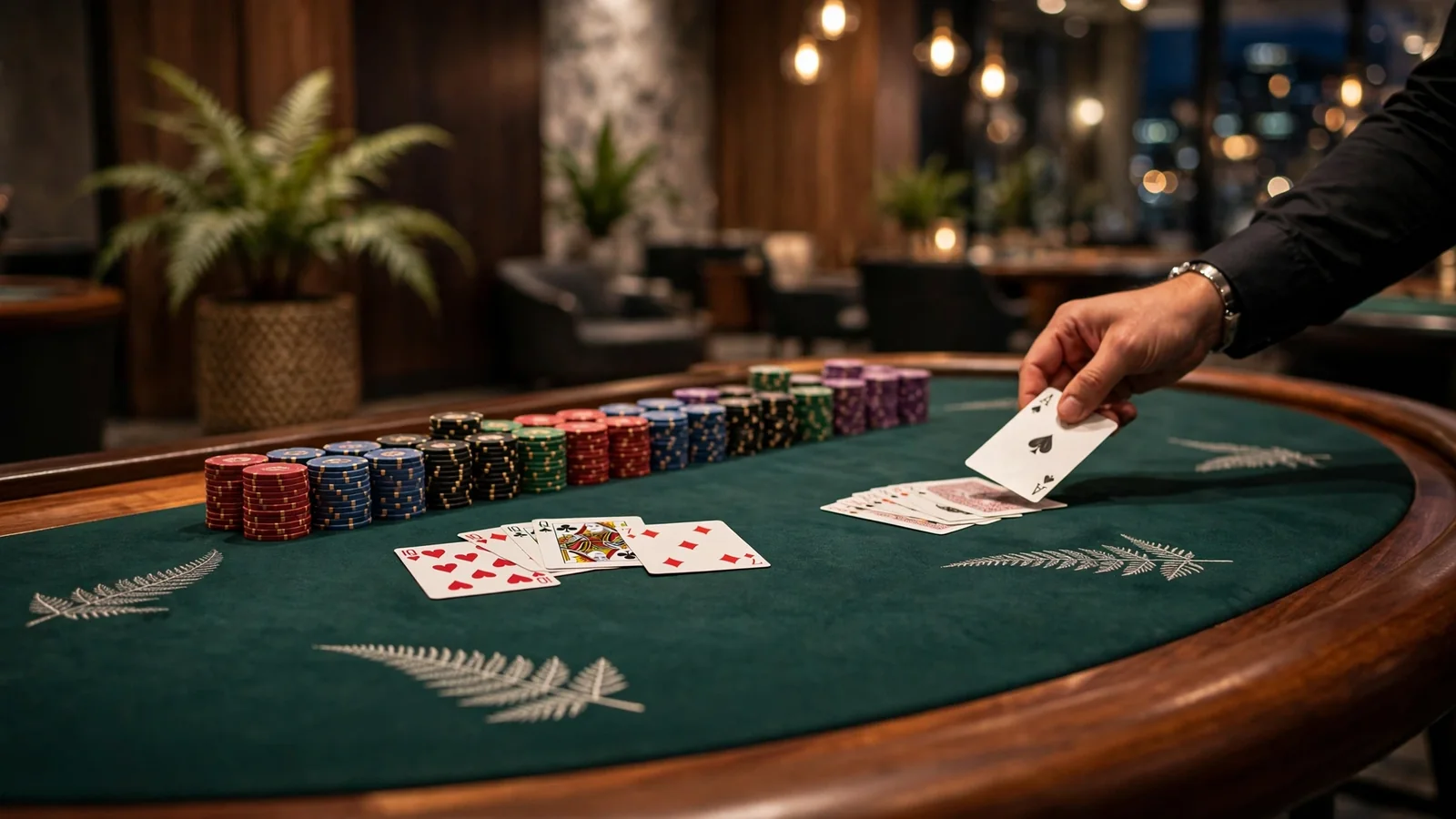
The Blackjack Round, from Deal to Decision
Blackjack is a contest against the dealer, not a race to reach twenty-one at any cost. The aim is to finish with a hand closer to twenty-one than the dealer’s, while staying at or below that total. A hand that goes over twenty-one is bust, and it cannot win against a dealer who remains in play. The distinction matters: a modest total can be enough if the dealer goes bust, while a higher one can still lose if the dealer finishes closer.
A round begins when the table accepts wagers and deals cards to the players and dealer. The precise dealing procedure can depend on the game, but the working pattern is straightforward: each player considers their own hand, makes any permitted decision, and then the dealer completes the dealer hand under the table’s rules. The player’s decisions come first. The dealer does not choose freely in the same way; the printed rules determine how the dealer must play.
At a casino table, the sequence is visible: cards arrive, players act in turn, and the dealer settles the hands once the dealer’s play is complete. In an online game, the same basic contest may be presented through software or a live dealer, but the structure of a hand remains recognisable. The display can make the process look faster or more polished than it is. The essential question stays the same: can the player improve or hold the hand without exceeding twenty-one, and will that result beat the dealer?
Choosing where to play blackjack in New Zealand means checking what reliable information is available about each casino before you sign up. This list highlights the specific details provided for each operator.
-
Play Grand
- License
- Malta Gaming Authority, licence no. MGA/B2C/370/2017
Play Grand lists a Malta Gaming Authority licence, number MGA/B2C/370/2017.
-
Lamabet
- Payout speed
- 1-3 business days
Lamabet lists a payout speed of 1–3 business days.
-
7Bit Casino
- License
- Tobique Gaming Commission, licence no. 0000091
7Bit Casino lists a Tobique Gaming Commission licence, number 0000091.
-
BitStarz
- License
- Curaçao Gaming Authority, licence no. OGL/2024/165/0185
BitStarz lists a Curaçao Gaming Authority licence, number OGL/2024/165/0185.
-
N1 Casino
- License
- Malta Gaming Authority, licence no. MGA/B2C/394/2017
N1 Casino lists a Malta Gaming Authority licence, number MGA/B2C/394/2017.
-
Zotabet
- License
- 07017519840
- Payout speed
- 1-3 business days
Zotabet lists licence number 07017519840 and a payout speed of 1–3 business days.
-
Ricky Casino
- License
- Tobique Gaming Commission, licence no. 0000002
Ricky Casino lists a Tobique Gaming Commission licence, number 0000002.
-
Neospin
- License
- Tobique Gaming Commission, licence no. 0000064
Neospin lists a Tobique Gaming Commission licence, number 0000064.
-
Wintino
- Payout speed
- 1-3 business days
Wintino lists a payout speed of 1–3 business days.
A player can hit to take another card or stand to keep the current total. Depending on the table, doubling down or splitting may also be available. Those choices are part of the hand, not separate games. Their availability and conditions belong to the rules on the table, so the same decision may not be possible in every version. Surrender is another option in some games, though it is not universal. There is no need to treat every choice as a move that must be used; the point is to understand what the table permits before a hand reaches the decision stage.
Once the players have acted, the dealer completes the hand according to the posted procedure. The outcomes then follow from the totals. A player who has gone over twenty-one loses that hand. If the player remains in play, the result depends on the comparison with the dealer: a closer total wins, a dealer who goes over can leave a surviving player as the winner, and equal totals generally produce a push rather than a win for either side. The settlement is mechanical. It is not a judgement about whether the player made a sensible choice.
A natural blackjack is a starting hand made from an ace and a ten-value card. It is distinct from reaching twenty-one after taking additional cards, and tables may treat its payout differently from an ordinary win. A specialist blackjack review describes a 3:2 payout for a natural, while noting that some tables instead pay 6:5. That difference affects the return on a winning natural; it does not change the target of the hand. The felt or game information should state the applicable payout, rather than leaving the player to infer it from the word “blackjack.”
The dealing sequence can create a pause while a dealer’s card is checked or while players wait for others at the table. That pause does not alter the object of the game. Every hand is still resolved by comparing a player’s live total with the dealer’s, under the conditions in force for that particular game. A table’s deck count, its treatment of a dealer’s soft seventeen, surrender availability and blackjack payout can vary. Specialist reviews flag these as rule differences worth checking, not as details that can safely be assumed to match from one game to another.
The most common early mistake is to read “twenty-one” as an instruction to keep drawing until the number appears. It is not. A player can lose by exceeding the target, and can win without reaching it if the dealer’s result is worse. The decision is therefore made with two outcomes in mind: the risk of busting and the possibility that the dealer will finish with a weaker hand. That is the basic tension of the round.
For someone learning how to play blackjack at a casino, it helps to watch the order rather than trying to memorise every decision at once: wagers are placed, cards are dealt, players act, the dealer completes the hand, and the table settles the result. Each stage has a job. The wager establishes what is at stake, the player’s turn determines whether the hand changes, and the dealer’s turn supplies the comparison. No complicated theory is needed to follow that sequence.
The same outline applies whether play is physical or online, though the interface and dealing style can differ. What should not be assumed is that every blackjack table uses identical rules or pays a natural in the same way. A familiar name is not a complete specification. Read the table information, follow the action in order, and keep the objective in view: finish closer to twenty-one than the dealer without going over. That is the round.
Practising Blackjack Online Without Stakes
Free online blackjack can be useful as a rehearsal space: it lets a beginner follow the rhythm of a hand and get used to making choices without risking money. The purpose is specific. Practice is not about making a session last longer or treating virtual chips as a measure of skill; it is about recognising what happens on screen and understanding when the game expects a decision.

The format matters. Online RNG blackjack uses software shuffles and generally moves faster than a live-dealer game. A new hand can begin as soon as the previous one is settled, so the pace may leave less time to think. That can make a digital table efficient for learning the interface, but speed is not the same as clarity. I would slow down deliberately: read the dealer’s prompt, identify the available controls, then decide rather than clicking by habit.
A live-dealer table presents a different rhythm. It uses actual cards and is closer to sitting at a casino table, with a dealer handling the cards on camera. Streaming can introduce delays, and live games may require higher bets. Those features can make a live format less suitable for cost-free practice, depending on what is available. A streamed table is not automatically a no-stakes table; the format and the stakes are separate things.
When a free mode is offered, it can help answer practical questions that written explanations leave open. Where does the hand total appear? How does the game show that the dealer has finished? Does the interface make a chosen action clear before the hand continues? These are small points, but uncertainty about the controls can distract from learning what is happening. The screen may differ from one game to another, so familiarity with one layout should not be mistaken for familiarity with every blackjack table.
DO
- Use practice to understand game procedures and interface controls.
- Pause to identify available actions before clicking.
DON'T
- Click by habit without reading the dealer's prompt.
- Assume familiarity with one layout applies to every blackjack table.
I use practice to separate two kinds of uncertainty. One is procedural: what the game is waiting for, what a button does, and how the hand advances. The other is strategic: which available action makes sense under the table’s rules. A free session can help with the first and provide a place to think through the second, but it cannot establish that a particular choice will win. A correct process can still end in a losing hand. That is part of the game, not evidence that the practice mode has failed.
The most useful practice is deliberate rather than repetitive. Before acting, pause long enough to say what the screen is showing and what the choice would do. After the hand, review whether the decision followed the table’s options and rules, rather than judging it only by the result. A hand that wins does not prove the decision was sound; a hand that loses does not prove it was poor. Outcomes alone are a blunt teacher.
Free play also has limits as a rehearsal. It may not reproduce the pressure of real-money play, and the table settings may not match those of another game. The rules can differ, as can the pace and presentation. This means a person can become comfortable with a particular interface while still needing to check a different table’s instructions. The distinction is easy to miss. Familiarity is not mastery.

Some people look for a no-download way to practise, while others prefer an installed game or a live stream. The delivery method does not determine whether the activity is genuinely free, nor does it tell much about how closely the experience matches another table. The important check is whether the game is clearly presented as having no monetary stake. If a page mixes free play with deposit prompts or promotional language, the boundary between rehearsal and gambling can become less obvious.
I regard “free” as a description of the immediate play mode, not a promise about what follows. Moving from practice to real-money gambling changes the decision. Before doing so, the terms attached to any offer matter: blackjack may count differently towards wagering requirements, and maximum-bet rules can apply while those requirements are active. Those conditions do not improve the practice experience; they govern a separate activity with financial consequences.
For learning the mechanics, a short, focused session is more useful than clicking through hands without attention. The point is to become less occupied with the buttons and more able to follow the game. No stake required.
Free Play for Fun: Keep the Session in Perspective
Free blackjack can be a straightforward form of entertainment: the point is the session itself, not a cash return. In a clearly labelled no-stakes mode, the chips are part of the game rather than money being risked. That distinction matters. A relaxed game with no financial stake is not the same activity as wagering, even when the screen and cards look similar.
I have seen “free” do more work in a label than it does in the terms behind it. Sometimes it means play without depositing; sometimes it refers to a promotion with conditions attached. The practical test is whether the game is genuinely no-stakes or whether a bonus or other offer connects it to real-money play. If money is involved, it is no longer casual free play in the ordinary sense.
For an easygoing session, the best boundary is a clear one: entertainment ends when the free mode ends. There is no need to turn a relaxed game into a test of skill or a target to beat. A session can be enjoyable without tracking every outcome or treating a run of hands as evidence that a win is due. Blackjack variants differ in their rules, and those differences can affect strategy and the house edge. A free game with one set of rules should not be treated as a promise about how another table will behave.
Some people prefer to play blackjack for fun in a browser, while others may look for a version that does not require a download or includes sound. Those are format preferences, not guarantees about what any particular game offers. Availability, controls and audio can vary. A quiet game may suit a shared space; sound may make a session feel more like an arcade-style diversion. Neither feature changes the distinction between play without stakes and gambling with money.
The time boundary matters as much as the money boundary. Free play can stretch because there is no bet prompting a pause, and a casual session can quietly become a long one. I find it useful to decide what the session is for—passing time, unwinding, or sharing a game—and stop when that purpose has been met. No elaborate tracking required.

When play does involve money, set a budget before starting and treat it as the cost of entertainment, not as a figure to recover. Once it is spent, stop. Chasing losses—raising stakes or continuing because earlier money has gone—turns a chosen leisure expense into a reaction to the last result. That is a poor basis for a decision. A budget is a boundary, not a prediction of what a session will return.
Promotional language can blur these categories. “Free” play may be separate from a bonus, or it may sit beside wagering requirements that affect how bonus funds can be used. Maximum bet rules can also apply while wagering requirements are being met. Before any real-money play connected to an offer, the terms deserve a close read on a trustworthy site or casino. The wording is part of the product.
Free play is most useful as leisure when it stays free in fact, not just in the headline. No stake, no recovery mission, no pressure to make the session prove something. Just a game.
Online Casino Blackjack and New Zealand’s Licensing Transition
A question about where to play online blackjack in New Zealand now has a legal answer that depends on the transition date, not just on the game or the website. The Online Casino Gambling Act 2026 created the country’s first domestic licensing system for online casino gambling. It took effect on 1 May 2026, but the full licensed regime is not expected to be operating until 2027.
That gap matters. The Act sets a transitional period from 1 May to 1 December 2026. Providers that were already serving people in New Zealand before the law took effect may continue during that period, subject to its transitional provisions. Providers that have not applied for a licence must stop offering online casino gambling in New Zealand by 1 December. If an application is declined, the provider must leave the market and cease those operations. Unlicensed operation is expected to become an offence around mid-2027, and operators may face enforcement action and fines of up to NZ$5 million.
The division of responsibility is deliberate. The Department of Internal Affairs is New Zealand’s primary gambling regulator and oversees regulation of the online casino licensing framework. The Gambling Commission hears and decides casino licence applications, issues online casino licences, and approves changes to licence conditions. In practical terms, the Commission makes licensing decisions; the Department oversees the wider regulatory framework.
Before the new Act, the Gambling Act 2003 did not permit online casinos to be based in New Zealand. Online casino gambling supplied from offshore was not licensed or supervised by a New Zealand regulator. A customer using an offshore site in that period had no domestic government recourse. The new framework changes the position for providers, but it should not be mistaken for a blanket endorsement of every site that remains accessible during the transition.
This is where promotional language can blur important distinctions. A site being available, or describing itself as “trusted”, does not establish that it holds a New Zealand licence. During the transitional period, advertising online casino gambling to people in New Zealand is prohibited. Once licensed operators are able to advertise, they will still face tight rules, and sponsorships are prohibited. Licensed operators must also use stricter age and identity checks.
Questions about live blackjack, playing with friends, or a casino bonus do not alter the licensing test. Those are product or promotion details; they do not show whether a provider is permitted to operate under the new framework. Nor does a bonus make a site regulated. Where real-money play is involved, terms can affect how blackjack contributes to wagering requirements, and maximum bet rules may apply during wagering. The small print does the work.
I have seen how a transitional label can sound more settled than it is. “Available now” describes access, not the final status of the licensing regime. During this changeover, the relevant distinction is between providers covered by the transitional provisions and those that must stop operating. Licensing is the point of the transition. Not the banner.
Strategy Starts with the Rules on the Table
A blackjack strategy is not a set of instructions that works unchanged everywhere. The table’s rules shape the decisions available and can affect both strategy and the house edge. I learned to treat the rules as part of the game, not fine print to skim after choosing a seat.
Deck Count
The number of decks used can affect strategic calculations.
Dealer Rules
Whether the dealer hits or stands on soft 17 changes the game.
Surrender
Availability of the surrender option affects available decisions.
Start with the conditions that can alter how a hand is played. The number of decks matters to some strategic calculations. So does whether the dealer hits or stands on soft 17, and whether surrender is allowed. These details can change which decision is appropriate in a particular situation. A strategy chart made for one set of rules may not fit another.
Payouts deserve the same attention. A specialist review notes that blackjack payouts can differ between tables, including tables offering different returns for a natural blackjack. That is a condition to verify, not a market-wide standard to assume. The displayed game rules are more useful than a general claim that a table is “standard”. Standard for whom?
The practical point is not to memorise every possible variation before playing. It is to identify which rules apply, then use guidance designed for those conditions. When a rule is unclear, the strategy built on it is uncertain too. A polished interface does not make two games equivalent.
I have seen players focus on the choice in front of them while overlooking the structure that gives that choice its meaning. A decision can be sensible under one rule set and less suitable under another. That is why learning blackjack strategy starts with reading the table information, rather than looking for a universal “best way to play”. There is no system that guarantees a win.
House edge is also shaped by the rules, so comparing games by their name alone tells little about their conditions. Two tables labelled blackjack may differ in ways that matter to both the expected cost of play and the decisions a player should make. The label is a starting point, not a specification.

Promotional wording can blur this distinction. “Favourable rules” sounds precise, but it means little unless the actual conditions are stated. I look for the details that affect play, and treat vague claims as sales language rather than strategy advice. Small print counts.
Strategy is therefore conditional: first establish the rules, then choose guidance that matches them. If the rule set changes, the advice may need to change as well. That approach does not remove chance or promise a result. It does prevent a common mistake: applying confident advice to a game it was never written for.
Playing with Others—and What Card Counting Can and Cannot Tell You
Blackjack can be played with two people at one table: both players make their own decisions against the dealer. The presence of another player does not turn the hand into a team game. Each person’s result is settled separately, and another player’s choice may affect which card appears next without changing the rules governing anyone else’s hand.
Online, the social element depends on the format. A live-dealer table can bring several players into the same game, while an RNG game may be played without visible opponents. Seeing other people at a table is not the same as sharing control of a hand, and their decisions are not a dependable guide to what to do. From behind the counter, I learned to separate the table’s atmosphere from the information that actually matters. Different things.
Card counting is often discussed as if it were a software feature or a guaranteed edge. The narrow legal point in New Zealand is that counting cards through mental calculation is not illegal. That does not mean every method of gaining information is permitted, nor does legality establish that counting will work in a particular game.
Online RNG blackjack uses software shuffles and moves at a faster pace than live-dealer play. That matters because a mental count depends on keeping track of cards already dealt and using that information before the game’s card sequence is reset. A software shuffle disrupts that continuity. Faster play can also leave less time to track and assess what has appeared. A counting app or other automated tool does not remove those limitations, and counting is not a reliable online advantage where the game reshuffles through software.
Live-dealer play is different in that actual cards are used, but that alone does not make card counting a practical edge. The relevant conditions are how cards are dealt and when the supply is reshuffled; the mere presence of a camera and a dealer does not settle either point. Nor does a display showing other players reveal enough to make their choices useful as a counting system.
The “team play” image can be misleading. People may share a table or talk about decisions, but that does not give them control over the deal or turn a count into a forecast. Mental arithmetic is lawful; certainty is not.

Blackjack Games: The Same Aim, Different Rules
Blackjack is a family of games built around a shared aim: finish closer to 21 than the dealer without going over. But the word “blackjack” on a screen or table is only a broad label. It does not tell the whole story of how that particular game works.
I have seen players assume that familiarity with one version carries over unchanged to another. The basic idea may feel recognisable, while details in the rules alter the conditions of play. A game’s rules can specify how many decks are used, how the dealer handles a soft 17, whether surrender is available and what a natural blackjack pays. Those details are not decoration. Different rules can change the house edge and make a decision that suits one version less suitable for another.
That is why a casual game, a casino table and an online version should not be treated as interchangeable just because each is called blackjack. The presentation may differ too: a screen-based game and a live-dealer table offer different formats, but the format alone does not explain the rules. The table or game information is the useful reference.
The same caution applies to versions designed for quick, informal play. A simple interface can make a game look self-explanatory, but it may not show every condition at a glance. I look for the rules before assuming that a familiar name means familiar terms. Small print matters.
There is no single set of conditions that defines every blackjack game. Variants retain the central contest against the dealer, yet their rules can shape both the available decisions and the mathematical setting around them. Calling something blackjack describes the broad game, not a promise that it plays exactly like another version.
A label is a starting point. The rules are the substance.
What a Blackjack Hand Is Worth
A blackjack total comes from adding the values of the cards in a hand. Number cards count at the number printed on them; face cards count as ten. An ace is the flexible card: it can be valued as one or eleven, depending on which total works without taking the hand over twenty-one.
That flexibility is not a bonus added on top of a fixed total. It is a choice of how to count the same card. A hand containing an ace and a six can be read as seven or seventeen. Add a face card, and the ace is counted as one: the total is seventeen rather than twenty-seven. The lower value keeps the hand within the limit.
I find it useful to do the arithmetic in two passes. First, count the ace as eleven and add the other cards. If that total exceeds twenty-one, count the ace as one instead. If there is no ace, or counting it as eleven would still take the hand over the limit, the values are simply added as they stand. No hidden arithmetic.
When a hand has more than one ace, each ace is assessed in context. The values can be adjusted so the combined total remains valid; an ace does not have to keep the same value as another ace in the hand. This matters because the printed cards alone do not always tell the whole story. The ace’s value depends on what is beside it.
The distinction between a card’s face and its blackjack value is worth keeping clear. A face card contributes ten, not a separate value for its rank. A number card contributes its own face value. The ace is the exception, with its one-or-eleven treatment.
For example, a hand with an ace, a number card worth five, and a face card can total sixteen: the ace is counted as one, since eleven would put the sum over twenty-one. The cards have not changed. Only the ace’s count has.
That is the whole calculation: add the cards, account for the ace, and keep the total at or below twenty-one. Straight arithmetic.
A Beginner’s First Decisions at the Table
For someone new to blackjack, the decision words matter more than any supposed system. The available choices depend on the table’s rules, so the same situation may not offer the same options everywhere. I learned to treat the action menu as part of the game, not as fine print to ignore.
Hit means taking another card. It can improve a hand, but it can also push the total over the limit. Stand means keeping the hand as it is and taking no more cards. Those are the basic choices: ask for more, or stop.
Calculating Totals
-
1
Count the ace
First, count the ace as eleven and add the other cards.
-
2
Check the total
If that total exceeds twenty-one, count the ace as one instead.
Double down means increasing the wager in exchange for a restricted next step, commonly one additional card before the hand ends. It is not simply a way to keep drawing until the total feels comfortable. The table’s terms determine when doubling is allowed and what happens afterward, so the label alone does not tell the full story.
Split turns an eligible starting hand into separate hands, each played on its own. That can create more decisions and may require another wager. Whether a split is allowed, and what follows it, depends on the rules in force. A player who chooses it should understand that the hands can produce different outcomes.
Some tables also allow surrender. This lets a player give up a hand under specified conditions, rather than continue playing it. It is not available everywhere, and the timing matters. A choice that sounds like an easy exit can be unavailable at the moment it is considered.
I have seen new players focus on memorising action names while missing the conditions attached to them. That is backwards. The practical starting point is knowing what each action does, then checking which choices the table permits and when. No elaborate method required.
A beginner does not need a special device or a betting theory to understand these decisions; the essential requirement is a clear grasp of the options offered in the game. Insurance may also appear as a choice, but it is generally not a bet most players should use.
The menu is not universal. Read the terms first. Simple, but important.
Simulators, Bets and Playing Two Hands
A blackjack simulator can make decision-making visible without turning each choice into a wager. I use the idea of a rehearsal: pause at a hand, consider the available action, then see how the hand develops. The point is not to prove a system or predict the next card. It is to notice whether a decision followed the rules in front of you, rather than a vague memory of how blackjack works.
The options may include hitting, standing, doubling down or splitting, depending on the game. A simulator’s controls and rules are not universal, so its display should be treated as part of the exercise. If a choice is unavailable, that may reflect the particular conditions it models. A practice session is useful only when those conditions are clear.
“Realistic” is a label, not a description. What matters is whether the exercise makes the relevant rules and choices understandable. I would not assume that a generic blackjack bet and play simulator reproduces a particular casino table, or that a result from practice transfers neatly to another version of the game.
Playing two hands at once is also different from splitting a pair. With two hands, separate hands are in play against the dealer; splitting turns one starting hand into two when the table permits it. Handling both can make the session busier, but it does not change the aim of making decisions under the table’s rules. More activity is not an edge.
A useful rehearsal keeps attention on the decision, not just whether the hand wins. A sensible choice can lose, and a poor one can happen to win. That distinction is easy to miss when results are judged one hand at a time. Keep notes on the rule or decision that caused uncertainty, then revisit that point rather than treating a short run of outcomes as evidence of a winning method.
If play moves from simulation to real money, set a budget and do not chase losses. Check the fine print and bonus conditions on trustworthy sites and casinos before playing: blackjack may count differently towards wagering requirements, and maximum-bet rules can apply while wagering. Read the conditions first.
Casino Games in New Zealand: Roulette, Blackjack & More
Content created by the «casinoguidenz.com» team