
Understand the decisions behind each blackjack hand
 Available in US
A guide to how dealer-versus-player hands, table rules and available actions shape blackjack play in New Zealand.
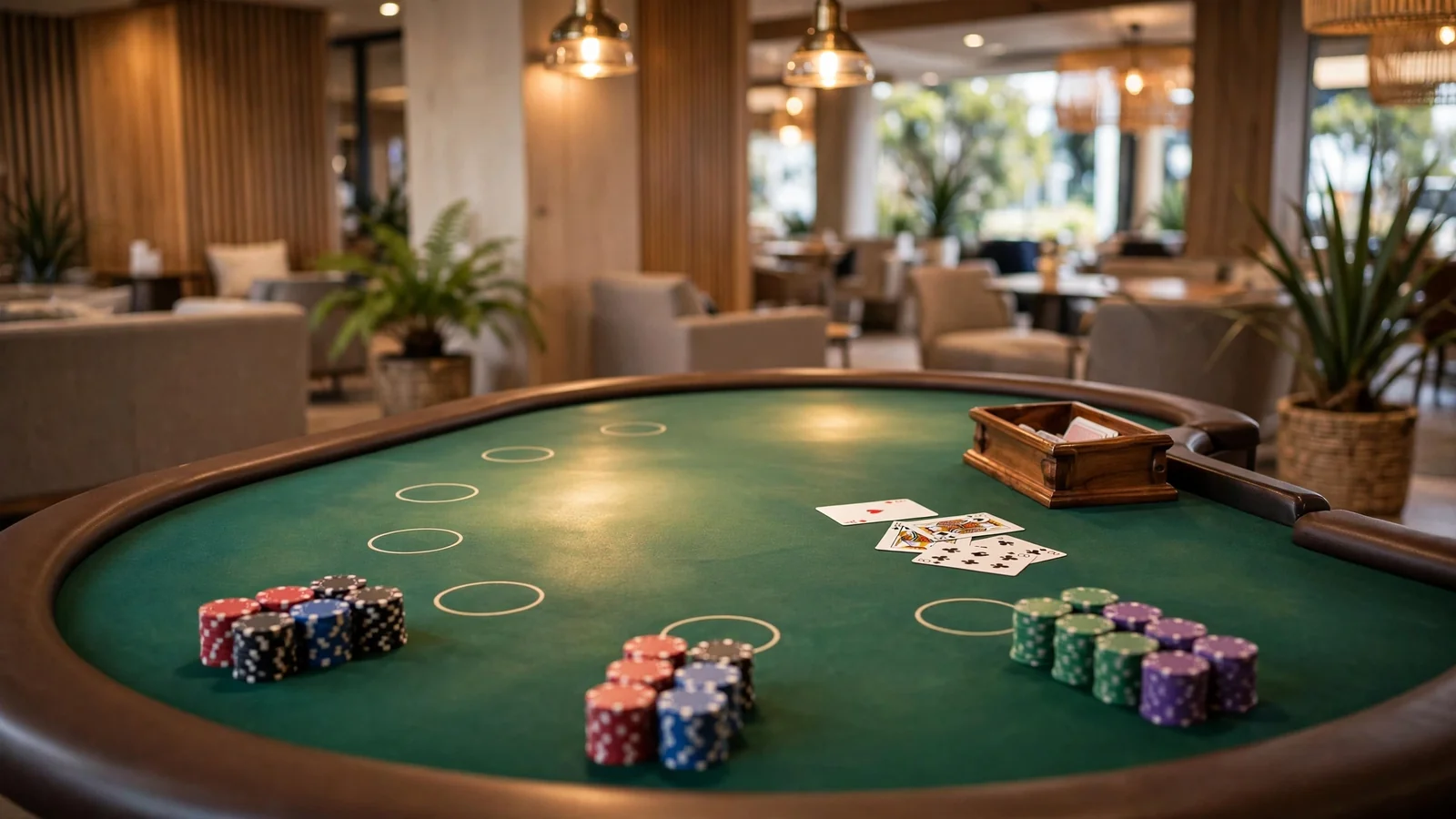
What Happens Around a Blackjack Table
Blackjack is a contest between each player and the dealer, not a competition among the people seated together. The aim is to finish closer to 21 than the dealer without going over. That simple comparison explains the table’s central arrangement: the dealer has a position of their own, while players occupy separate places around the same playing surface.
A casino blackjack table is designed to make those separate hands visible. The dealer works from the curved or straight side of the table, and the player positions face inward across the felt. Each position gives a hand its own space. The table is shared, but the hands are not pooled. A player’s result is assessed against the dealer’s hand rather than against a neighbour’s cards or total.
That distinction is easy to miss when several people are playing at once. A busy table can look like a group game, with players watching one another and reacting to the same cards. In practical terms, though, each position remains its own contest with the dealer. A player may care about the choices made around the table, but those choices do not turn the other players into opponents whose totals must be beaten.
The dealer is the constant reference point. Their hand gives the table a common comparison, and the dealer manages the shared flow of play. From the counter side, that role is less theatrical than it can appear in films. The dealer is not there to outguess the table or to compete with one particular player. The job is to keep the game moving and apply its stated conditions consistently across the positions in use.
The felt helps organise that work. Player spaces indicate where a hand belongs; the dealer’s area is distinct. Chips, cards and hands can therefore be associated with the correct position even when the table is active. The layout is functional rather than decorative. It reduces ambiguity about which hand belongs to which player and where the dealer’s hand sits in relation to them.

People sometimes speak of a blackjack table as though it were one collective hand. That is not how the comparison works. Several players can be present, but each is trying to finish closer to 21 than the dealer without exceeding it. One player’s outcome does not establish another player’s result. The same dealer can be the reference point for all of them, while each position is judged separately.
This is also why the social atmosphere can differ from the structure of the game. Players may exchange comments, watch cards appear, or pause to see what happens elsewhere on the felt. Those moments create a shared room, not a shared wager or a single team objective. The table can feel communal while the underlying comparisons remain individual.
The phrase “21 table” can suggest that the number alone defines the experience. It does not. The number describes the target around which the contest is framed; the dealer’s hand supplies the comparison. The point is not simply to reach 21 at any cost. Going beyond it defeats the aim of finishing closer without exceeding the target. The table’s basic logic is comparative, not a race to produce the largest possible total.
A blackjack table therefore has two kinds of order. There is the physical order of the layout: a dealer’s station, marked player positions and room for the cards and chips associated with each hand. Then there is the order of the game: individual players are measured against the dealer, not ranked against one another. The first makes the activity legible; the second explains what the activity is about.
That context matters before considering any particular table’s conditions. The surface may look familiar from one game to another, but the layout alone does not tell the whole story. It shows where the dealer and players sit and how hands are kept distinct. It does not, by itself, explain every rule governing play. Those details belong to the specific game, not to the general idea of a blackjack table.
A first glance can make blackjack seem complicated because several hands may be visible at once. The basic relationship is more contained: one dealer, individual player positions, and a comparison centred on 21. Everything else on the felt serves that structure. Clear enough. Just not a team game.
Rules That Change the Price of a Blackjack
The felt can look identical while the terms of play are different. In blackjack, the dealer’s soft-17 rule, the number of decks, surrender availability and the payout for a natural can all change from one game to another. These details are not decoration around the table. They define how particular hands are treated and can affect the house edge.
The word “price” here is not the cost of taking a seat. It is the value attached to a result under the posted rules. A natural blackjack—a starting hand made from an ace and a ten-value card—may receive a different payout from an ordinary win. A game can therefore look familiar and still return a different amount for the same natural. The label alone does not settle the terms.
A specialist review describes natural-blackjack payouts of 3:2 at some tables and 6:5 at others. That is a reported comparison, not a fixed statement about every casino or a guarantee of what a current table offers. The distinction is material: for an identical stake, the lower ratio pays less when a natural occurs. The table’s displayed rules, rather than a general description of blackjack, determine which payout applies.

A natural also needs to be distinguished from a hand that reaches the same total after taking another card. The payout rule concerns the specific starting hand, not simply any route to a total of 21. A short line in the rules can therefore carry more weight than the game’s broader title. “Blackjack pays” is incomplete until the qualifying hand and its payout are clear.
The dealer’s treatment of soft 17 is another point to inspect. A soft total contains an ace counted as 11 without making the hand exceed 21; soft 17 is such a hand totalling 17. The rules may require the dealer to take another card or to stop. That instruction changes the dealer’s permitted play, and the variants do not all use the same instruction. No dramatic redesign is needed: a single rule on the dealer’s hand can alter the game’s overall terms.
Deck count works in a less visible way. A blackjack game may use a different number of decks from another, even when both are presented as the same broad game. That is a rule difference, not a cosmetic choice. Together with dealer behaviour and payout terms, it can affect the house edge. A title such as “classic” does not tell enough; the specific table rules do.
Surrender is not available under every set of rules. Where it is offered, the table defines the circumstances in which a player can give up a hand under that option. Where it is absent, that choice is not part of the game. It should not be assumed from seeing the word blackjack on a lobby tile or table sign. The exact conditions matter, and a short description may omit them.
Do
- Check the natural payout ratio
- Inspect the dealer's soft-17 instruction
- Verify the deck count
- Confirm if surrender is available
Don't
- Assume all blackjack variants are interchangeable
- Rely on general descriptions of the game
- Ignore the specific table rules in favour of a title
This is why blackjack variants should not be treated as interchangeable. Their rules can affect both strategy and house edge, even when the cards, dealer and basic aim appear familiar. A lower natural payout, a different soft-17 instruction, a different deck count or the absence of surrender each changes the framework in which a hand is played. These differences do not promise a particular result for any session. They change the terms, not the certainty.
In practice, the useful comparison is the rule panel attached to the particular table. I have seen broad game labels do little work; the details do the real work. Check the natural payout, the dealer’s soft-17 instruction, the deck count and whether surrender is listed. If a feature is not stated clearly, the label should not be taken as proof that it applies. Small print matters.
Online Blackjack in New Zealand: The 2026 Licensing Shift
Use this list as a starting point when exploring blackjack tables in New Zealand in 2026. Check the details relevant to you before choosing a table.
-
Play Grand
- License
- Malta Gaming Authority, licence no. MGA/B2C/370/2017
Play Grand lists a Malta Gaming Authority licence, number MGA/B2C/370/2017.
-
Lamabet
- Payout speed
- 1-3 business days
Lamabet lists a payout speed of 1–3 business days.
-
7Bit Casino
- License
- Tobique Gaming Commission, licence no. 0000091
7Bit Casino lists a Tobique Gaming Commission licence, number 0000091.
-
BitStarz
- License
- Curaçao Gaming Authority, licence no. OGL/2024/165/0185
BitStarz lists a Curaçao Gaming Authority licence, number OGL/2024/165/0185.
-
N1 Casino
- License
- Malta Gaming Authority, licence no. MGA/B2C/394/2017
N1 Casino lists a Malta Gaming Authority licence, number MGA/B2C/394/2017.
-
Zotabet
- License
- 07017519840
- Payout speed
- 1-3 business days
Zotabet lists licence number 07017519840 and a payout speed of 1–3 business days.
-
Ricky Casino
- License
- Tobique Gaming Commission, licence no. 0000002
Ricky Casino lists a Tobique Gaming Commission licence, number 0000002.
-
Neospin
- License
- Tobique Gaming Commission, licence no. 0000064
Neospin lists a Tobique Gaming Commission licence, number 0000064.
-
Wintino
- Payout speed
- 1-3 business days
Wintino lists a payout speed of 1–3 business days.
An online blackjack table can look familiar while operating through a very different system from a physical casino. In an RNG game, software shuffles the cards, and play can move faster than at a live-dealer table. The screen presents the game; it does not, by itself, show which New Zealand rules apply to the service behind it.
That distinction matters in 2026. The Online Casino Gambling Act 2026 created New Zealand’s first domestic licensing framework for online casino gambling and took effect on 1 May 2026. It marks a change from the earlier position, when online casinos could not be based in New Zealand and offshore services were not licensed or supervised by a New Zealand regulator. Customers using those offshore sites had no domestic government recourse. The framework regulates providers; it does not mean that every blackjack table visible online has already entered the new licensing system.
A transition, not an overnight change
The Act allows a transition from 1 May to 1 December 2026. Online casinos that were already serving people in New Zealand before the Act began may continue during that interval under its transitional provisions. That permission is tied to the transition; it should not be mistaken for a permanent licence or a general opening for new providers.
The full licensed regime is not expected to be operating until 2027. Until then, the market is in an interim state: the law has established the route to domestic licensing, but the final system is not yet fully in place. The Act also sets a later enforcement direction. Unlicensed operation is expected to become an offence from around mid-2027. Providers that have not applied for a licence must stop online casino gambling in New Zealand by 1 December 2026; if an application is declined, the provider must end its local operations and leave the market.
These dates describe provider obligations, not a deadline for players to choose a table. Residents can still access offshore services, and playing with an offshore casino does not make the customer criminally liable. Access is not the same as domestic oversight. That distinction has long been the awkward part of the market.
Who does what
The Department of Internal Affairs is New Zealand’s primary gambling regulator and oversees regulation of the online casino licensing framework. The Gambling Commission has a separate decision-making role: it hears and determines casino licensing applications, issues online casino licences, and approves changes to licence conditions. The two bodies are not interchangeable. One provides the broader regulatory oversight; the other handles licensing decisions and conditions.
For an online blackjack table, this structure concerns the provider and the terms under which it may operate, rather than the mechanics shown on screen. A digital shuffle does not tell a player whether a provider has applied, whether an application has been determined, or what conditions govern a licence. Those are regulatory matters, not features of the game interface.
The transition also carries restrictions on promotion. Advertising to people in New Zealand is prohibited during this period. Once licensed operators are permitted to advertise, that activity remains subject to tight rules, and sponsorships are prohibited. Licensed providers must also use stricter age and identity verification systems. Operators that breach the framework may face enforcement action and fines of up to NZ$5 million.
The practical point is that “online” covers more than one regulatory position. A software blackjack table may run quickly and resemble other casino games, while the status of the service depends on its operating history, its application and the transitional rules. The licensing shift changes the market around the table—not the shuffle on the screen.

Strategy Starts With the Decision, Not the System
Blackjack strategy is not a promise about what the next hand will do. It is a way to make decisions consistently, given the rules of the particular game. That distinction matters: variants can change both the decisions that make sense and the house edge. A chart prepared for one set of rules may not fit another table.
I learned to treat a strategy chart as a reference, not a machine. Its recommendations depend on details such as how many decks are used, whether the dealer draws on soft 17, whether surrender is allowed and how a natural blackjack is paid. Those conditions are not decoration in the small print; they are inputs. Change an input and the suggested play may change too.
Charts have conditions
A basic strategy chart sets out a mathematically considered response to a hand and the dealer’s visible card under specified rules. It does not forecast a win, and it cannot remove the house edge. A blackjack probability table may help explain the likelihood of outcomes, but probability describes a range of possible results, not what a particular hand must produce.
The same caution applies to a blackjack pay table. It records what a game pays, while the table’s other rules shape the context in which those payouts operate. A surrender table is useful only when surrender is offered and when its recommendations match the game’s conditions. A chart with no rule set attached is an incomplete tool.
A private blackjack table does not become more favourable simply because it is private. The relevant question remains what rules apply and whether they match the assumptions behind any strategy reference. Presentation is not mathematics. Small print matters.
Systems are not guarantees
Progression systems often dress a betting pattern up as a solution: increase after a loss, reduce after a win, or follow a sequence until it turns. None of those approaches changes the cards or guarantees a profitable result. A run of losses can continue, and changing bet size does not make a weak game favourable. “Smart system” is marketing language; underneath, it is still a pattern of bets exposed to the same game.
I have seen the language around systems shift the focus away from the terms of play. The table rules determine the conditions; a betting pattern does not rewrite them. Considered play means understanding those conditions, using a strategy reference that fits them and accepting that individual results remain uncertain. No magic sequence.
Card counting is a different subject from a betting progression. In New Zealand, using mental calculation alone to count cards is not illegal. That legal point should not be confused with a claim that counting is effective in every format. Online RNG blackjack uses software shuffles; where the cards are automatically shuffled, a running count from earlier hands does not provide a dependable basis for the next one.

Keep the money terms separate
A strategy decision and a promotion’s terms are not the same thing. Before playing for real money, the fine print and bonus conditions on trustworthy sites and casino pages need to be checked. Blackjack may contribute differently to wagering requirements, and maximum bet rules can apply while those requirements are being met. A bonus headline says little about those mechanics.
I keep a budget separate from any strategy chart. Once losses prompt larger bets intended to recover them, the plan has changed from considered play to chasing. No chart can make that safe or guarantee a recovery. The most useful discipline is often deciding in advance what the session can cost, then stopping when that budget is reached.
Strategy begins with the actual rules, not a slogan or a system. Charts can organise decisions; they cannot promise the outcome.
Bets, Chips and Electronic Tables
A blackjack bet is committed before a hand begins. At a physical table, chips make that commitment visible: the player places them in the betting area, and the dealer can see the stake without needing to ask. The chips are not just decoration. They are the table’s working record of what has been wagered, while the cards and decisions that follow determine how the hand is played.
The same basic sequence appears in digital blackjack, though the interface replaces felt and chips with a marked betting area and on-screen controls. A player selects a stake, confirms it, and then takes part in the hand. Depending on the table’s rules, the available actions include hitting, standing, doubling down or splitting. The screen may make these options look like simple buttons; in practice, their availability is controlled by the game’s rules, not by the design of the software.
An electronic blackjack table game can refer to more than one format. In RNG blackjack, software deals the cards and uses software shuffles. That removes the pauses associated with a live dealer handling cards, so hands can move more quickly. The pace is partly a product of the interface: when a hand ends, another can begin without waiting for a physical shuffle or a dealer to clear the table.
That speed changes the feel of betting. A screen can move from one hand to the next with little ceremony, making it easy for the stake and the next decision to blend into a continuous routine. I have seen how much table design depends on reducing friction. “Instant” play often means fewer pauses, not more time to consider what has just happened. A deliberate pace matters.
Live-dealer games retain the handling of actual cards, while software games streamline the process. That distinction is not a promise about outcomes; it is a difference in how the game is conducted. A player moving between formats may find the same broad set of actions presented through different controls, with electronic play generally moving faster.
The money side deserves the same attention as the controls. A stake should be treated as a planned expense, not adjusted to recover an earlier loss. Set a budget and do not chase losses. Where a bonus is involved, the fine print matters: blackjack may count differently towards wagering requirements, and maximum-bet rules can apply while those requirements are being met. Those terms affect how funds can be used, even when the table itself appears straightforward.

The key distinction is practical. Chips or an on-screen stake mark the wager; the controls govern participation in the hand; and the format sets the pace. Electronic play removes some pauses, but it does not remove the need to keep track of the money being put into play. Shorter gaps. Same responsibility.
When to Hit, Stand, Double or Split
Each decision changes what can happen to the hand in progress. The available choices depend on the table’s rules, so the same hand situation may not offer the same options everywhere. I keep the distinction simple: taking a card, ending the hand, changing the stake, or separating a pair.
Hit means asking for another card. The player may hit again or stop, provided the hand has not gone over 21. It is the active choice: the total can improve, but another card can also take it beyond the limit.
Stand means taking no more cards and leaving the hand as it is. The dealer then completes the dealer’s part of play. Standing does not make the hand stronger; it fixes the player’s total and leaves the result to the comparison that follows.
Double down combines a larger wager with a narrower choice. The player adds to the original bet and takes one more card, then the hand is finished. A table may restrict when doubling is allowed, so the option should not be assumed simply because the move exists in blackjack.
Hit
Ask for another card to try and improve the hand total.
Stand
Take no more cards and leave the current hand total as it is.
Double Down
Increase the original wager and take exactly one more card.
Split
Separate a pair into two separate hands by placing an additional wager.
Split is available when the first two cards form a pair. The pair becomes two separate hands, each played on its own. That also means the player must place an additional wager for the second hand. A split does not erase the original decision; it creates another one, and the table’s rules govern how each hand proceeds.
Some tables also offer surrender. This ends the hand early in exchange for giving up part of the wager rather than playing on. It is not available everywhere, and the timing or conditions can be set by the table.
These moves are not interchangeable. Hitting keeps the hand open; standing closes it. Doubling changes the stake while limiting the hand to one further card. Splitting turns one hand into two. Surrender exits the hand under a specific rule. The distinction matters in the moment because once a choice is accepted, the options can narrow quickly.
At the counter, I saw confusion arise when a player treated a familiar move as an entitlement. It is not. The table decides which actions it permits and when they can be used. A displayed minimum, such as a five-dollar table label, does not by itself state the maximum bet; that is a separate table condition.
The useful habit is to identify the action before choosing it. Plain mechanics.
Live Tables and the Seat at the Table
A live-dealer blackjack table occupies a middle ground between a casino floor and a software game. The cards are real and handled at a physical table, while the game is watched and played through a video stream. That changes the feel of the session: the dealer’s actions are visible, but the view is framed by cameras rather than by a seat in the room.
The stream is part of the game’s practical conditions, not decoration. A delay can separate what appears on screen from what is happening at the table, and the pace may feel less immediate than software blackjack. Live tables may also call for higher bets than software versions. That difference matters before a hand begins; the table’s terms, not the camera quality, determine whether its pace and entry conditions suit a player.
I have found that “immersive” is often used as shorthand for the presence of a dealer and physical cards. What it leaves out is the small friction of a streamed interface: the action has to be seen, registered and returned through a connection. A pause may be technical rather than part of the dealer’s rhythm. Not the same room.
Choosing a seat at a physical blackjack table is mainly a matter of comfort and visibility. A position with a clear view of the cards, dealer and other players makes it easier to follow the hand. Some people prefer to sit where they can see the dealer’s movements without leaning around another player; others value a little more personal space. These preferences affect how easy the game is to follow, not the odds.
In an online live game, “seat” can mean a place in the table interface rather than a chair beside the dealer. The camera may show the whole table, while the player’s own decisions are made through on-screen controls. A seat selection can therefore shape the view or the sense of participation, but it does not change the cards dealt. The best place to sit at a blackjack table is the one that gives a clear view and feels comfortable, not a position imagined to improve the result.
Before joining, the useful comparison is between the live table’s stated conditions and the software alternative: the live stream brings physical cards and a dealer, while software play uses generated dealing and can move faster. If the stream stalls or the pace feels awkward, the format may be a poor fit even when the table looks convincing. Practical comfort first. No lucky seat.
Reading the Cards Before Reading a Chart
A blackjack chart is easier to read once the card values are clear. The arithmetic is spare: number cards count at face value, face cards count as ten, and an ace can count as one or eleven. The ace is the only card whose value can shift within a hand.
| Card | Value |
|---|---|
| Number card | Its face value |
| Jack, queen or king | 10 |
| [Ace | 1 or 11](https://lionspincasino.com/blackjack) |
That small table is the foundation. A hand with a seven and a four totals eleven. A hand with a king and a six totals sixteen. With an ace, the total depends on which value keeps the hand from going over twenty-one: an ace and a six can count as seven or seventeen.
In the card room, I saw people get tangled up by treating an ace as fixed. It is not. The hand total is read with the ace at eleven when that works; if that would push the hand beyond twenty-one, the ace counts as one instead. That is why the same ace can represent different totals without changing the cards on the table.
The term “soft” describes a total that includes an ace counted as eleven. A total without that flexibility is called “hard”. The distinction matters when reading a blackjack table chart because the chart may separate hands by whether an ace is present. The card values have not changed; only the hand’s available total has.
A natural blackjack is a two-card hand made from an ace and a ten-value card. Its arithmetic is straightforward, but the table’s payout terms are a separate matter. The value of the cards tells how the hand is counted, not what the casino pays for it.
- Soft Total
-
A hand total that includes an ace counted as 11 without making the hand exceed 21.
I keep the first pass literal: identify each card, assign its value, then account for the ace. Once that is clear, chart labels stop looking like another set of rules. Just arithmetic.
A Cheat Sheet for the Choices a Table Allows
A blackjack table’s action buttons can look familiar from game to game, but the available choices depend on its rules. I treat a cheat sheet as a translation of those buttons, not as a formula for what to choose. The same label can sit within different table conditions.
| Action | What it means |
|---|---|
| Hit | Take another card for the hand. |
| Stand | Keep the hand as it is and take no more cards. |
| Double down | Increase the bet for the hand and take a further card under the table’s terms. |
| Split | Separate a pair into two hands, where the table permits it. |
| Surrender | Give up the hand under the conditions set by the table. |
The first four are the core actions players encounter in blackjack. Surrender is another possible choice, not a universal feature. A display may show only actions that are currently available, while the written rules explain when they can be used. That distinction matters: a button shown for one hand or game does not establish that the same option applies everywhere.
I learned to read the table’s wording before treating a quick-reference card as complete. A cheat sheet can explain what “hit” or “split” means, but it cannot override a rule that restricts an action. Nor does it decide which option is right for a particular hand. It is a reference for the permitted moves.
Keep the lookup plain. Identify the action, understand its basic effect, then check whether that table allows it in the situation at hand. If surrender is absent from the rules, it is not an available choice; if doubling or splitting is restricted, the table’s conditions govern. No hidden system. Just the table’s terms.
That is the useful form of a blackjack table cheat sheet: a compact guide to the language of the controls, paired with the rules for that game. A chart that leaves out those conditions can make a choice look universal when it is not. The wording on the table is part of the game. Read it closely.
Table Limits and the Rules Behind Them
A table limit is part of that table’s terms, not a fixed feature of blackjack. The minimum and maximum shown at the table define the permitted stake range there; another game may set a different range. That distinction matters because a limit label says nothing by itself about the other conditions attached to play.
I have seen players compare tables by the amount they can wager and treat the one with the higher ceiling as the more flexible option. That is only one part of the comparison. A table’s rules can also differ on deck count, whether the dealer hits or stands on soft 17, whether surrender is available, and how a natural blackjack is paid. The limit and those rules belong in the same inspection.
A lower minimum can make a table accessible at a smaller stake, but it does not tell the whole story of its terms. A higher maximum is not evidence of a better deal either. Limits describe the range of permitted bets; rules describe how hands are handled and settled. They answer different questions.
The phrase “high limit” sounds like a feature. In practice, it names a betting range, not a quality rating. The same goes for a low limit: it does not establish that the game is more favourable. Table conditions need to be read together rather than inferred from one prominent figure.
A specialist review may report a particular table’s limits or rules, but those details should be treated as specific to the game it examined, not as a market-wide standard. Tables can change, and a review does not replace the terms displayed for the selected game. Small print matters.
For a useful comparison, note the stated betting range alongside the table’s rules and payout terms. If one of those details is unclear, the comparison is incomplete. Limits set the boundaries. The rules set the context.
Casino Games in New Zealand: Roulette, Blackjack & More
Content created by the «casinoguidenz.com» team